
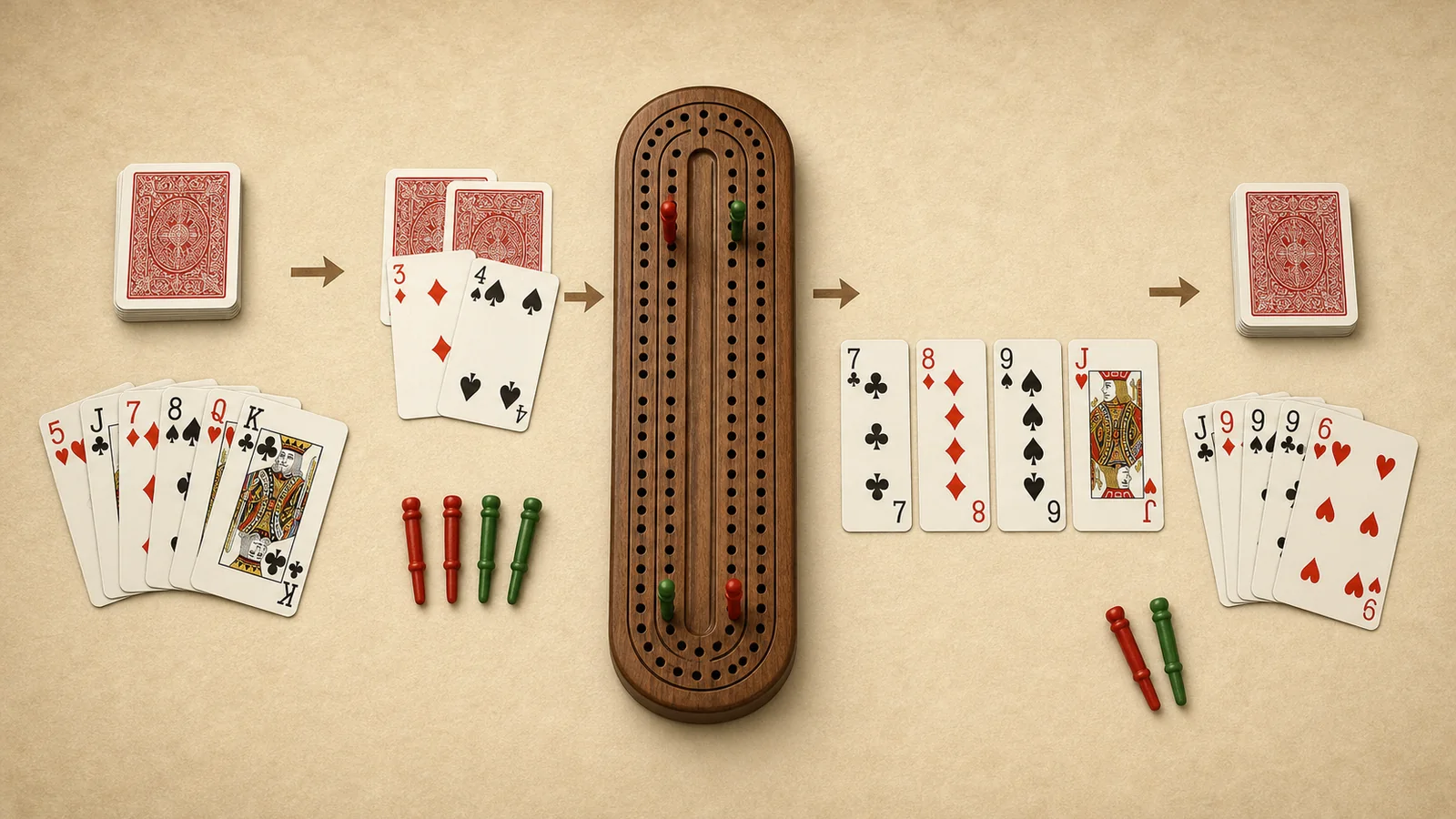
You need a standard deck, a cribbage board, and two pegs per player. If you do not have a board, paper scoring works while you learn. A full game goes to 121, but a first practice game to 61 is easier to finish.
1. Deal six cards to each player
Cut for the first deal; low card deals. The dealer gives one card at a time until each player has six. Keep your cards hidden from the opponent.
2. Discard two cards to the crib
Each player chooses two cards and places them face down. Together, those four cards form the dealer’s crib. The dealer will count it after both regular hands, so the dealer usually sends helpful cards while the non-dealer tries to send safer cards.
3. Reveal the starter
The non-dealer cuts the remaining deck. The dealer turns the starter face up. You will use that same card later when counting both hands and the crib. If it is a jack, the dealer pegs two immediately.
4. Play cards and peg points
The non-dealer plays first. Say the running total as you lay a card: “five,” then perhaps “fifteen,” and so on. The next card adds to the total, but nobody may take it above 31.
Score as soon as your card makes a fifteen, pair, run, or 31. During pegging, a run uses the most recently played cards. Their order on the table can be mixed as long as their ranks form an unbroken sequence.
Say “go” only when none of your remaining cards can be played legally. The other player continues. At 31—or when no more cards fit—the count returns to zero. Continue until all eight cards have been played.
5. Count the three hands
The non-dealer exposes four cards and adds the starter as a fifth. Count every combination of 15, every pair, every run, a qualifying flush, and nobs. Peg that total. The dealer repeats the process for their hand and then for the crib.
Counting in a fixed order prevents missed points:
- All fifteens
- Pairs and multiples
- Runs
- Flush
- Nobs
Use the cribbage scoring chart until these patterns become automatic.
6. Alternate the deal
Gather the cards, switch dealer, and play another hand. Keep leapfrogging the rear peg ahead of the front peg whenever you score. The first player to reach 121 wins immediately.
How to play cribbage online
The sequence is the same in a browser: deal, discard, starter, pegging, count. Many platforms automate the shuffle and scoring, which makes them useful for learning. To keep improving, predict each score before the software reveals it.
Playing against a computer
A computer opponent is useful when you want unlimited thinking time or need to pause. Choose a difficulty that lets you complete hands without rushing. If the platform shows a hand history, review your discarded cards and any scoring combinations you missed.
Playing with real people
Live opponents add time limits and varied styles. Learn the interface before entering a rated match, and use respectful table chat. Do not assume every site uses identical scoring options; check whether the game is to 61 or 121 and whether muggins is enabled.
Free and no-download safety checks
- Use the official website address and a current browser.
- Read the privacy policy before creating an account.
- Avoid installers when browser play is advertised as no download.
- Do not provide payment details for a genuinely free mode.
- Use a unique password if registration is required.
A simple first practice hand
Play with both hands face up. Talk through each discard, announce every running total, and count each hand twice. This removes memory pressure and lets you focus on the game’s structure. On the second hand, hide the cards and repeat the sequence normally.