
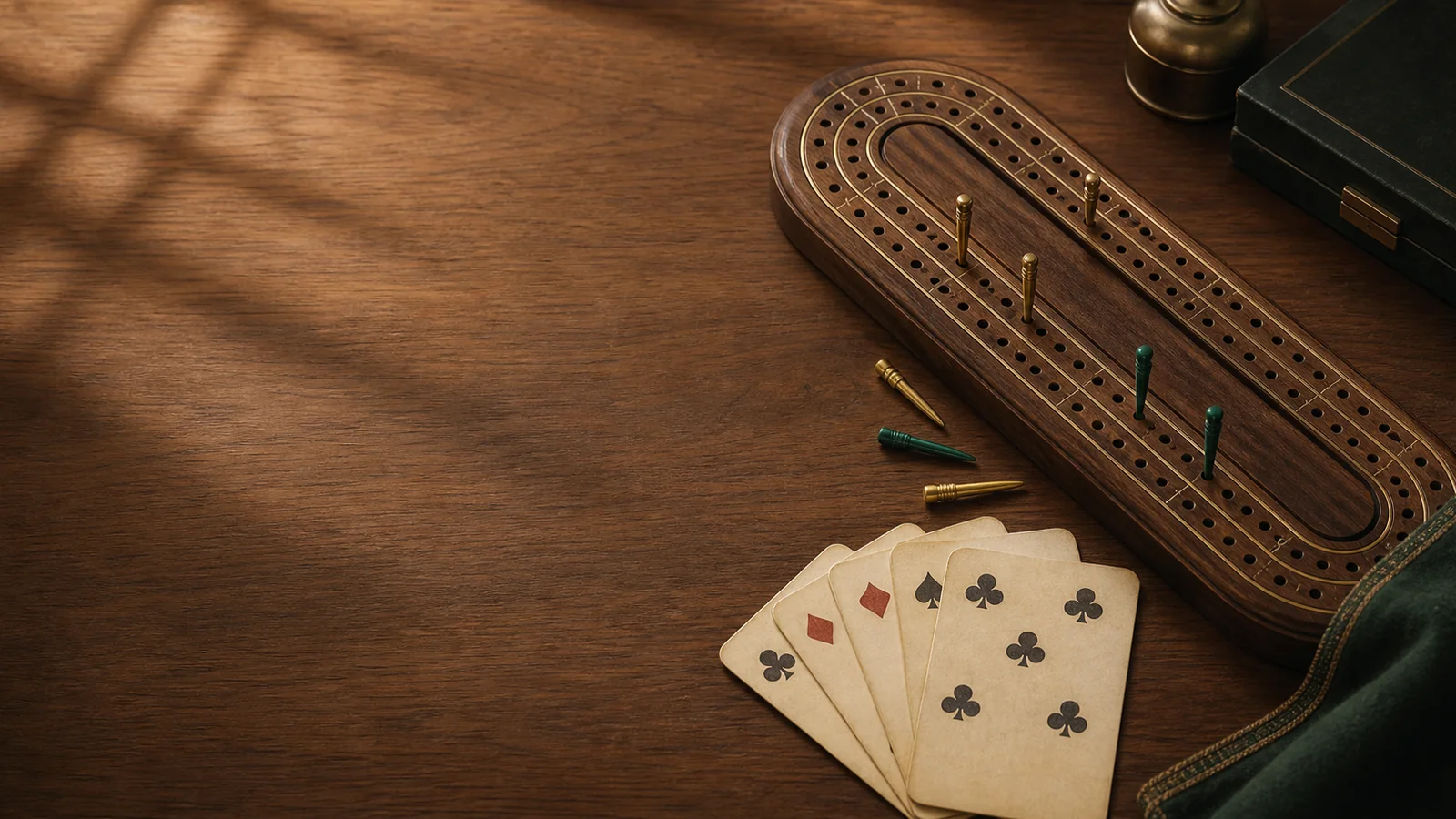
Most cribbage variations preserve fifteens, pairs, runs, flushes, and nobs. What changes is the number of cards dealt, how the crib is formed, whether pegging has opponents, and the target score. Always agree on the format before the deal.
Classic two-player cribbage
This is the standard modern game. Each player receives six cards and discards two to the dealer’s crib. The non-dealer leads the pegging round and counts first. The first player to reach 121 wins.
New players should learn this version first because most printed and online cribbage rules use it as their baseline.
Three-player cribbage
A common three-player format deals five cards to each player. Each discards one card to the crib, and the dealer adds one extra card from the deck to complete it. Players peg in rotation, skipping anyone who cannot play without passing 31.
Use a three-track board or clearly labeled markers. Scoring order begins with the player to the dealer’s left and continues clockwise, with the dealer and crib last.
Four-player partners
Four-player cribbage is commonly played as two partnerships. Each player receives five cards and contributes one to the dealer’s crib. Partners sit opposite and share one score track.
Table talk about cards should be prohibited. The partnership format makes pegging more tactical because your partner’s card can create or deny opportunities before play returns to you.
Five-card cribbage
This older short-game form deals five cards to each player, who discards two to the crib and keeps three. It is often played to 61. Some traditional rules give the non-dealer an initial three-point advantage called “three for last,” so confirm the local rules before starting.
Cribbage solitaire
Cribbage solitaire is a family of one-player exercises rather than one universal ruleset. A common version deals six cards, asks you to choose a four-card hand and two-card crib, then supplies additional crib cards and a starter from the deck. You score both sets and repeat for a fixed number of deals.
Other solitaire formats arrange cards into a grid and score rows or columns as cribbage hands. Because layouts differ, compare the published instructions rather than assuming every “cribbage solitaire” game follows the same deal.
Solo play is valuable for practicing discard evaluation and fast hand counting. It does not reproduce opponent-dependent pegging decisions.
Lowball cribbage
In lowball or losing cribbage, players generally try to finish with fewer points. Exact rules vary: some require points to be taken when available, while others penalize missed scores. This inversion changes discarding dramatically because normally strong combinations become liabilities.
Online format labels
Browser and app listings may use “classic,” “multiplayer,” “against computer,” “solitaire,” or “quick game” inconsistently. Before starting, check:
- Target score: 61 or 121
- Number of cards dealt and discarded
- Whether muggins is enabled
- Automatic or manual counting
- Live opponent, asynchronous opponent, or computer
- Rated or casual result
Quick comparison
| Format | Typical hand | Typical target | Best for |
|---|---|---|---|
| Classic two-player | 6 dealt, keep 4 | 121 | Standard competitive play |
| Three-player | 5 dealt, keep 4 | 121 | Small groups |
| Four-player partners | 5 dealt, keep 4 | 121 | Team play |
| Five-card | 5 dealt, keep 3 | 61 | Short traditional game |
| Solitaire | Varies | Score challenge | Counting practice |
| Lowball | Often classic deal | Varies | Experienced groups |