
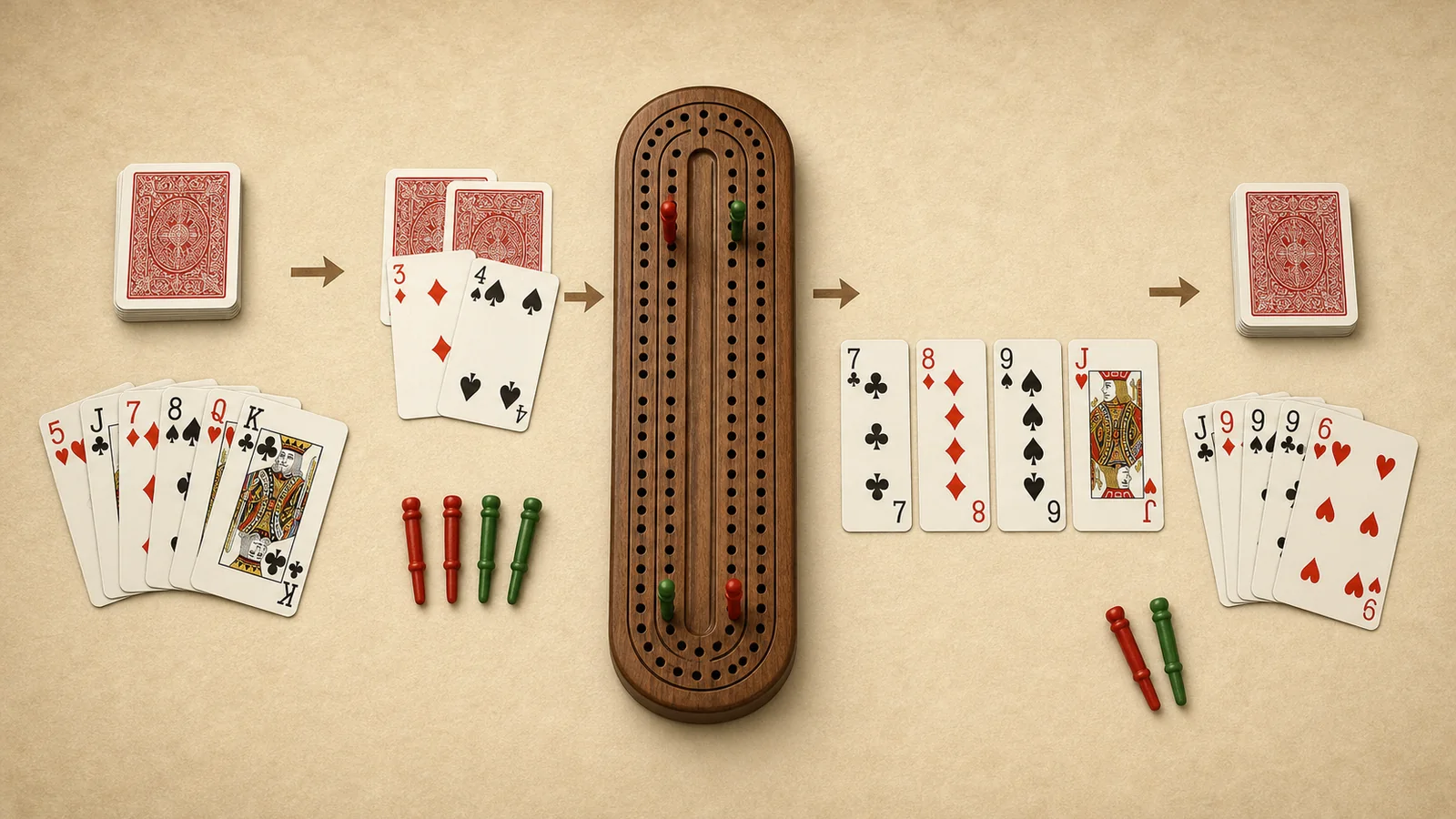
Cribbage awards points twice: immediately during the play and later when each five-card set is counted. Learn these as separate systems. Hand scores are based on all distinct combinations; pegging scores depend on the newest card and the recent sequence.
Hand scoring chart
| Score type | Points | How it works |
|---|---|---|
| Fifteen | 2 each | Every distinct subset of cards whose values total 15 |
| Pair | 2 | Two cards with the same rank |
| Three of a kind | 6 | Three pairs among three cards of the same rank |
| Four of a kind | 12 | Six pairs among four cards of the same rank |
| Run | 1 per card | Three or more consecutive ranks, regardless of suit |
| Double run of 3 | 8 | Two runs of three plus one pair |
| Double run of 4 | 10 | Two runs of four plus one pair |
| Flush in hand | 4 or 5 | Four hand cards match; add one if starter also matches |
| Flush in crib | 5 only | All four crib cards and starter must match |
| Nobs | 1 | Jack in hand or crib has the starter’s suit |
How to count fifteens
Card values are the same as during pegging: ace is 1 and face cards are 10. A fifteen may use two, three, four, or all five cards. Every different subset scores 2, even when one physical card also appears in another subset.
Example: 5, 5, 10, 10 with any unrelated starter contains four fifteens: each 5 can pair with each 10. That is 8 points for fifteens, plus 2 for the pair of fives and 2 for the pair of tens, for 12 total.
Pairs and multiples
A pair is 2. Three cards of one rank contain three different pairs, so they score 6. Four cards of one rank contain six pairs and score 12. This is why multiples are worth more than their names initially suggest.
Runs and double runs
A run needs at least three consecutive ranks. Suits do not matter. Duplicate ranks multiply the number of runs instead of extending the sequence.
Example: 3, 4, 4, 5 plus a king contains two 3-4-5 runs (6 points) and a pair of fours (2), totaling 8. This is a double run of three.
Ace is always low. A-2-3 is valid; Q-K-A is not.
Flushes and nobs
In a regular hand, four cards of one suit score 4 even when the starter differs. If the starter shares the suit, score 5. In the crib, all five cards must share a suit; otherwise the flush scores zero.
Nobs is one point for holding a jack that matches the starter’s suit. Do not confuse it with his heels, the two points the dealer receives when the starter itself is a jack.
Pegging score chart
| Play result | Points | Condition |
|---|---|---|
| Total of 15 | 2 | Your card makes the running total exactly 15 |
| Pair | 2 | Your card matches the immediately previous rank |
| Three of a kind | 6 | Three same ranks played consecutively |
| Four of a kind | 12 | Four same ranks played consecutively |
| Run | 3+ | Most-recent cards can be rearranged into consecutive ranks |
| Total of 31 | 2 | Your card makes exactly 31 |
| Last card | 1 | You play last before a reset without making 31 |
Worked hand example
Suppose your hand is 5♣, 5♦, 6♠, 7♥ and the starter is 8♣.
- Two fifteens: 7+8 using the only 7 and 8 = 2 points.
- One pair: the two fives = 2 points.
- Two runs: each five can join 6-7-8 = 8 points total for the two four-card runs.
The total is 12 points: 2 for fifteen, 2 for the pair, and 8 for the double run of four.
The 29-point hand
The maximum hand is 29. Hold three fives plus the jack whose suit matches the starter; the starter is the fourth five. Eight different fifteens score 16, six pairs score 12, and nobs scores 1.
There is no 19-point hand in standard cribbage. Players sometimes say “nineteen” humorously to announce a zero hand.
Scoring FAQ
Can the same card score more than once?
Yes. A card can belong to several distinct fifteens, pairs, or runs. Count combinations, not cards used.
Does a four-card crib flush count?
No. A crib flush requires all four crib cards and the starter to have the same suit.
Is 19 a possible cribbage hand?
No. Under standard scoring, no five-card set can total exactly 19.