
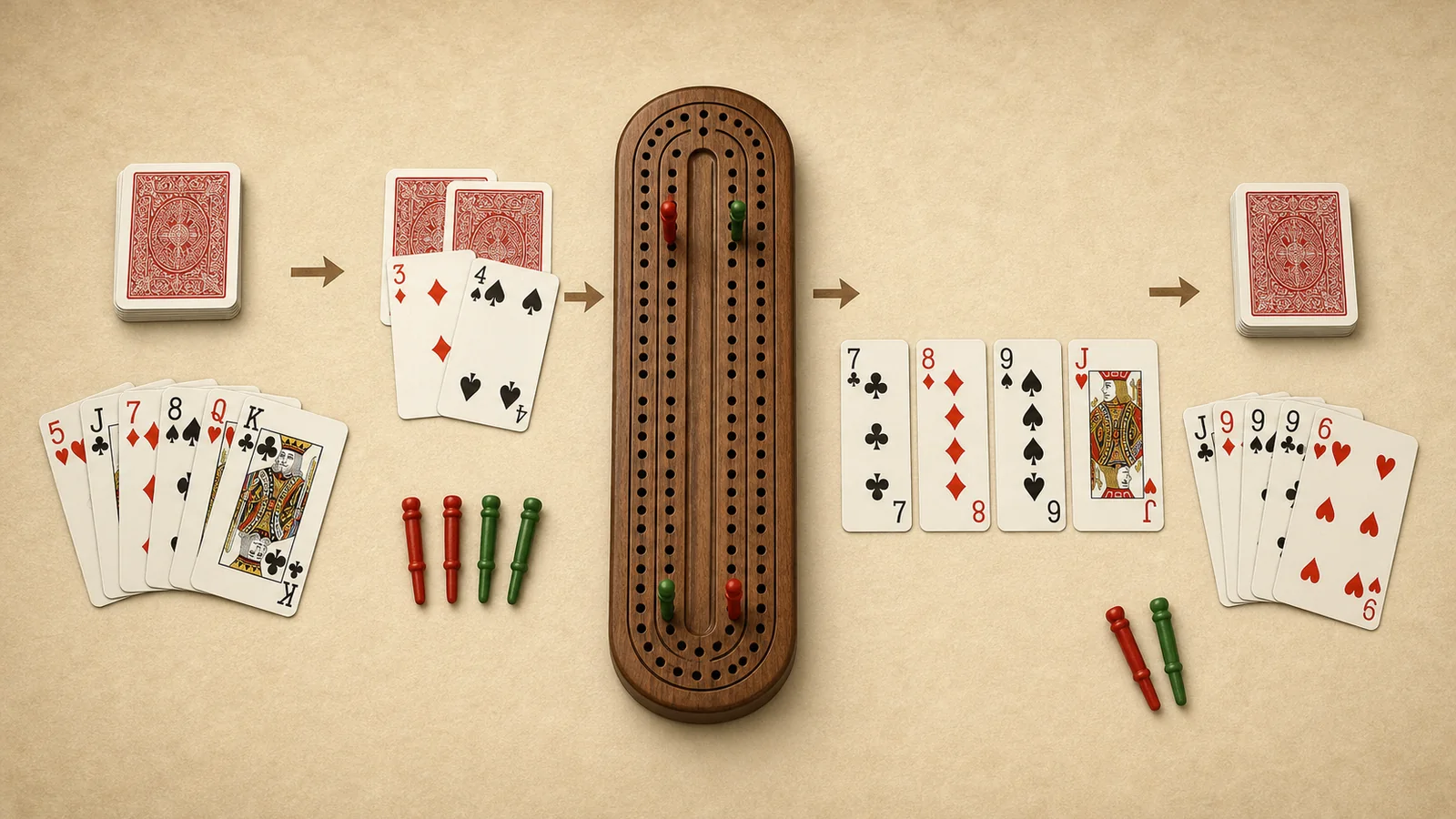
Classic cribbage is usually played by two people with a standard 52-card deck and a board for keeping score. The object is to be the first player to reach 121 points. Points come from playing cards in sequence and from combinations found in each completed hand.
Setup and first deal
Place two pegs for each player in the starting holes. The usual way to choose the first dealer is to cut the deck; the lower card deals. Aces are low. After every hand, the deal alternates.
The dealer shuffles and deals six cards to each player, one at a time. Each player chooses two cards and places them face down into the crib, a four-card extra hand that belongs to the dealer.
Cutting the starter card
After discards, the non-dealer cuts the remaining deck and the dealer turns up the top card of the lower packet. This is the starter, sometimes called the cut card. It belongs to neither hand, but both hands and the crib use it when they are counted.
If the starter is a jack, the dealer immediately scores two points for his heels.
The play, or pegging
The non-dealer lays one card face up and announces its value. Players alternate cards, announcing the new running total. Aces count 1; numbered cards count their number; jacks, queens, and kings count 10. The total may never exceed 31.
- Fifteen: making the running total exactly 15 scores 2.
- Pair: matching the immediately preceding rank scores 2.
- Three of a kind: three consecutive cards of one rank score 6.
- Four of a kind: four consecutive cards of one rank score 12.
- Run: three or more most-recent cards that can be arranged in rank order score their length.
- Thirty-one: making exactly 31 scores 2.
- Last card: the final card before a reset scores 1, unless it made 31 and already scored 2.
If a player cannot play without exceeding 31, that player says “go.” The opponent continues if possible. When neither can play, score last card if appropriate, reset the count to zero, and lead with the player who did not lay the last card.
Counting hands and crib
Once every card has been played, the non-dealer counts first. Then the dealer counts their own hand and finally the crib. Every hand is evaluated with the starter, creating a five-card set.
| Combination | Points | Rule |
|---|---|---|
| Fifteen | 2 each | Every distinct card combination totaling 15 |
| Pair | 2 | Two cards of the same rank |
| Run | 1 per card | Three or more consecutive ranks |
| Flush | 4 or 5 | Four hand cards of one suit; starter adds the fifth point if it matches |
| Nobs | 1 | Jack in the hand or crib matching the starter’s suit |
A crib flush is stricter than a hand flush: all four crib cards and the starter must share a suit to score five. A four-card flush in the crib scores nothing.
Winning the game
The first player to reach the game hole at 121 wins immediately. This can happen during pegging, while counting a hand, or through his heels. Once someone reaches 121, later scores are not counted.
A traditional skunk occurs when the loser has not passed 90 points. Some groups record a double skunk below 61, but that convention does not change the play of an individual game.
Common beginner mistakes
- Counting a four-card flush in the crib.
- Forgetting that the non-dealer counts before the dealer.
- Assuming ace can follow king. In cribbage, ace is always low.
- Counting only one way to make 15 instead of every distinct combination.
- Treating suits as relevant during pegging runs; only rank matters.
Rules FAQ
Who counts first in cribbage?
The non-dealer counts first. The dealer then counts their hand and the crib. This order matters because the first player to reach 121 wins immediately.
Can an ace be high in cribbage?
No. Ace is always low and worth one. A-2-3 is a run; Q-K-A is not.
Do you have to play a card if you can?
Yes. You may say “go” only when every card remaining in your hand would push the running total above 31.