
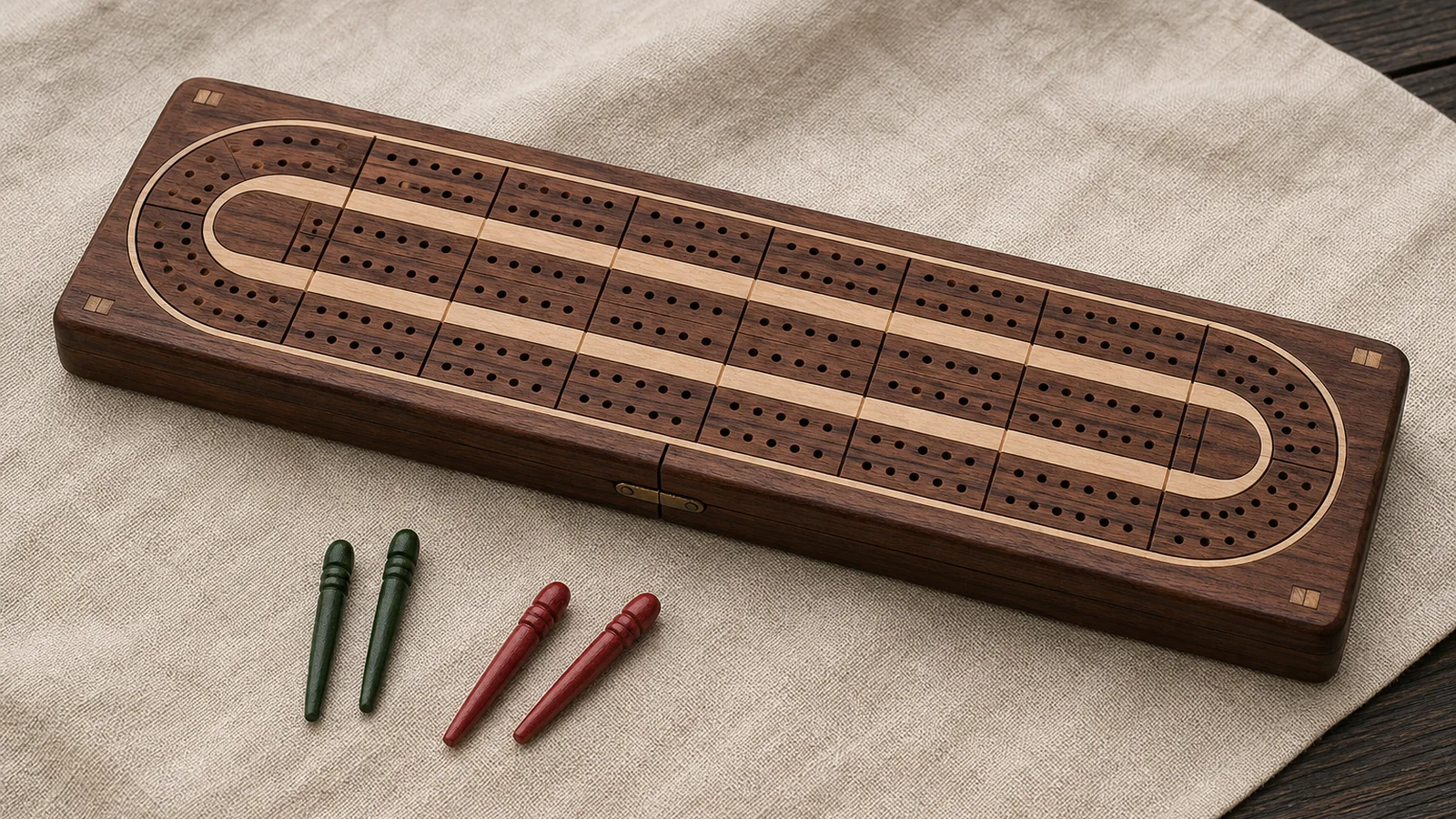
A cribbage board is a scorekeeper, not a required part of the card mechanics. It shows the race to the winning total clearly and prevents arithmetic disputes. Most boards use rows of grouped holes, separate tracks for players, and two pegs per track.
The standard layout
A modern full-game board represents 120 counted points plus a final game hole for 121. Holes are commonly grouped in sets of five, making movement easier to read. Depending on the design, the track may run straight, fold back on itself, or loop around a continuous shape.
- Starting holes: hold both pegs before scoring begins.
- Player tracks: parallel rows that keep scores separate.
- Five-hole groups: visual markers for quick counting.
- Game hole: the finish at 121.
- Skunk line: often marks 90 points on a 121-point board.
Why each player uses two pegs
Two pegs preserve the previous score while recording the new one. The rear peg always moves past the front peg by the number just scored. This leapfrog method creates an audit trail: if anyone questions the move, the old position is still visible.
Example: your front peg shows 24 and your rear peg shows 18. You score 7. Move the rear peg from 18 to 31, seven holes beyond the current front peg. The peg at 24 is now the rear peg for your next score.
121-hole vs. 61-hole boards
A compact 61-point board can support either a short game to 61 or a standard game completed in two trips. If playing to 121 on a short board, agree how you will mark the first lap. Some boards include a lap marker or separate game counters.
| Board type | Best use | Watch for |
|---|---|---|
| 121-point continuous | Clear standard games | Larger footprint |
| 61-point compact | Travel and short games | Needs a lap method for 121 |
| Three-track | Two or three players | Wider than a two-track board |
| Four-track | Doubles and groups | Confirm rules for team scoring |
Skunks and match holes
If the winner reaches 121 before the loser passes 90, the loser is skunked. Some boards mark this position. A double skunk below 61 is a popular match convention, but not every rule set scores it the same way.
Extra holes away from the main track may record games won in a match rather than points in the current game. Agree on their use before starting.
How to choose a board
- Tracks are visually distinct and easy to follow through turns.
- Pegs fit securely without binding or falling through.
- Five-point divisions are obvious in normal room light.
- The board supports the number of players you expect.
- Storage is available for pegs, and ideally a deck.
- Travel boards close securely and protect their pegs.
Wood species and decoration are matters of taste. Readability, stable pegs, and an unambiguous path matter more during play.
Scoring without a board
You can keep a running total on paper or with counters. Write both the previous and current total after each score to preserve the board’s audit-trail benefit. For a learning game, a printed 121-point track and two small markers work well.
Board care
Keep wood boards dry, remove pegs by lifting rather than bending, and store small metal pegs away from young children. If holes become tight from humidity, do not force oversized pegs; let the board return to normal indoor conditions.